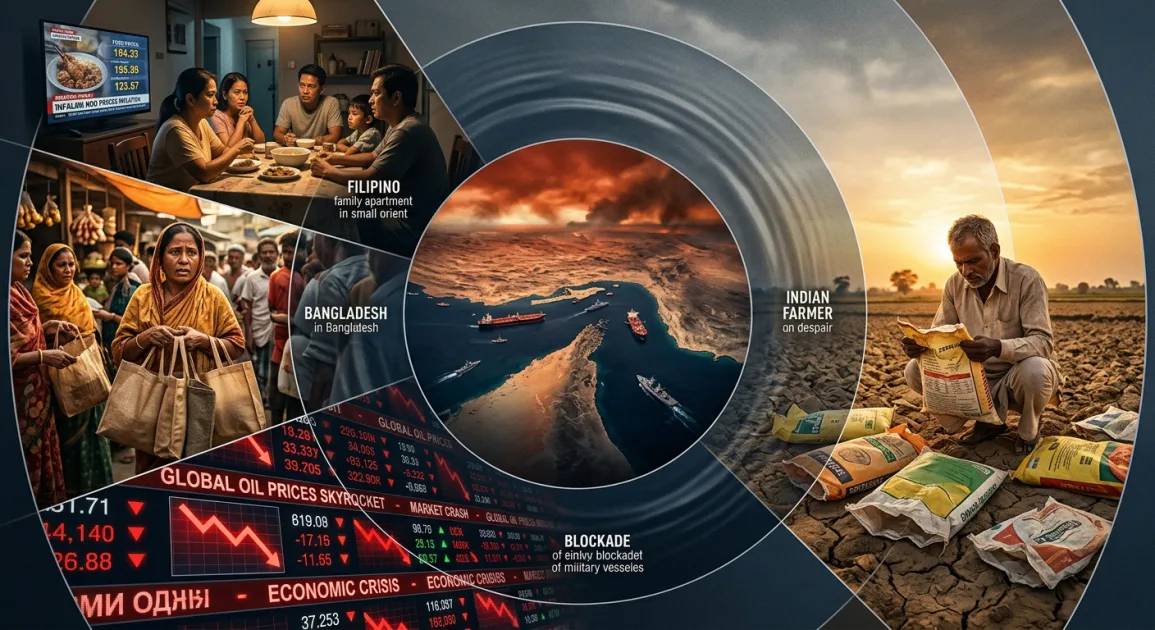
Oil is inside almost everything you use, buy, eat, or wear. It powers the trucks that deliver your groceries. It fuels the ships that bring your clothes. It heats your home and cools your food. When oil becomes expensive, everything becomes expensive — not next month, not next year, but within days.
Within just six days of the conflict beginning, crude oil prices jumped from around $60 per barrel to approximately $115 — nearly double in less than a week.
By April 2026, the annual inflation rate in the United States had jumped to 3.3% — the highest since May 2024 — driven primarily by higher energy costs linked to the Iran war. The US national average price of gasoline climbed above $4 per gallon for the first time in more than three years.
And America, remember, is one of the countries least exposed to this crisis. It has massive domestic oil production. It has reserves. It has alternatives. And even the United States was wincing at the fuel pumps.
Goldman Sachs projected that in an adverse scenario — where oil flows remain disrupted for ten weeks — Brent crude would peak at $140 per barrel. In a severely adverse scenario including infrastructure damage and ten weeks of disruption, oil could peak at $160 per barrel.
Mohamed El-Erian, chief economic advisor at Allianz, warned that the ongoing war was poised to deliver a significant inflation shock to consumers, with economic effects cascading from energy prices into broader household spending.
The Federal Reserve, which had been preparing to cut interest rates to stimulate growth, suddenly found itself trapped. Cut rates and inflation roars. Hold rates and the economy suffers. The war had cornered the most powerful central bank on earth.
The Countries Nobody Is Talking About
Here is where this story gets truly painful — and truly untold.
Every major news outlet covered the oil price surge. Every financial analyst wrote about the Fed's dilemma. Every stock market commentator discussed portfolio risk.
But very few people sat down and wrote about what was happening in Thailand, Vietnam, the Philippines, Bangladesh, and Pakistan — countries that had nothing to do with the conflict, no military involvement whatsoever, and yet were absorbing some of the most brutal economic damage.
In India, restaurants began warning of possible shutdowns as the government prioritized gas supplies for households. Thailand suspended overseas travel for civil servants and encouraged people to take stairs instead of elevators to save energy. The Philippines introduced a temporary four-day work week for some government agencies, while Vietnam encouraged people to work from home.
Think about the human reality behind those bureaucratic-sounding measures. A Filipino government employee who needs every working day's salary to pay rent and school fees suddenly loses one full day of income per week — because of a war being fought over a thousand miles away.
Singapore and Taiwan, which depend heavily on Qatari LNG, were placed under acute energy pressure. Pakistan and Bangladesh — both highly price-sensitive nations with fragile economies — were particularly exposed to the disruption.
On March 18, Iran struck Qatar's Ras Laffan Industrial City LNG complex, causing a 17% reduction in Qatar's LNG production capacity. Experts estimated the damage would take 3 to 5 years to repair. As a result, LNG spot prices in Asia increased by over 140%.
One hundred and forty percent. In weeks.
The Crisis Nobody Saw Coming: The Fertilizer Shock
If you asked most people what the Strait of Hormuz carries, they would say oil. They would be right — but dangerously incomplete.
Because passing through that same narrow waterway is something arguably more important than oil in the long run. Something that doesn't make headlines. Something that billions of people on earth depend on to eat.
Fertilizer.
Around 20% of global seaborne fertilizer exports originate from the Arabian Gulf. The dependency is even more pronounced for urea — the most widely used nitrogen fertilizer — with roughly 46% of global trade linked to Gulf producers. These exports are heavily directed toward India (18%), Brazil (10%), and China (8%), with additional significant shares going to Morocco, the United States, Australia, and Indonesia.
When the Strait closed, it didn't just trap oil tankers. It trapped the ingredients that farmers across four continents use to grow food.
Nearly half of the world's traded urea and large volumes of other fertilizers are exported from Gulf countries via the Strait of Hormuz. After Qatar's LNG facilities were attacked, QatarEnergy halted output at what is the world's largest urea plant after shutting down gas output.
The UN Food and Agriculture Organization's chief economist Máximo Torero stated clearly: "The loss of Gulf exports creates an immediate global shortfall with no quick substitutes." He added that unlike oil, there are no strategic international fertilizer stockpiles anywhere in the world.
With no stockpile and no substitute, the math becomes terrifying fast.
Some fertilizer plants in India, Bangladesh, and Pakistan had to stop production entirely as natural gas and oil prices spiked. Torero identified the countries most immediately at risk in South Asia as Bangladesh, India, Pakistan, and Sri Lanka. In East Africa, Sudan, Kenya, and Somalia would be most impacted. In the Middle East, Turkey and Jordan.
A farmer in Punjab who cannot afford fertilizer does not just earn less money. He grows less food. And when millions of farmers grow less food simultaneously, what follows is not an inconvenience — it is a hunger crisis.
363 Million People and a Record Nobody Wanted
The United Nations does not often use record-breaking language about hunger. When it does, the world should stop and listen.
The UN World Food Programme warned that as many as 45 million more people could face acute hunger if the conflict in Iran did not ease by mid-year — pushing the total number of people in acute food insecurity to 363 million. This would eclipse the hunger levels that followed Russia's invasion of Ukraine in 2022, which was already the worst food crisis in decades.
363 million people facing acute hunger. That is more than the entire population of the United States — facing the daily reality of not having enough to eat. Not because of drought. Not because of crop failure. Because a war between three nations blocked a 33-kilometer waterway.
The World Food Programme reported that 10,000 tons of food meant for hundreds of thousands of children in Afghanistan had yet to arrive — stuck in the logistical chaos created by the conflict.
Children in Afghanistan, waiting for food that is sitting in a ship that cannot move. That is the hidden human face of the economic impact of war — a face that never appears on the financial channels discussing oil price charts.
The Gulf's Own Grocery Emergency
Here is something that virtually no media outlet explored properly: the Gulf states themselves — the nations sitting on top of the world's oil — were facing a food crisis.
Arab states of the Persian Gulf rely on the Strait of Hormuz for their energy exports but also for over 80% of their caloric intake through food imports. By mid-March 2026, 70% of the region's food imports were disrupted, forcing retailers like Lulu Retail to airlift basic food staples, resulting in a 40–120% spike in consumer prices for everyday goods.
Read that again. A 40 to 120% spike in the price of basic food. In countries that are among the wealthiest per capita on earth. Countries that have sovereign wealth funds worth trillions of dollars. Countries that sell oil to the world.
Even they could not protect their own grocery shelves — because the war had cut the very route their food arrives by. Being rich in oil does not help you when the problem is not money, but logistics.
What the World's Stock Markets Said
When ordinary people feel economic pain slowly — through grocery bills and fuel costs — financial markets feel it instantly. And in early March 2026, markets around the world said exactly what they thought of the situation.
Stock markets experienced declines globally and there was a global bonds market sell-off simultaneously, as investors began pricing in stagflation — the toxic combination of high inflation and economic stagnation that is the hardest condition for any government to fix.
Stagflation is every central banker's nightmare. Normal inflation? Raise interest rates. Normal recession? Cut interest rates. Stagflation? Both solutions make the other problem worse. You are trapped.
Al Jazeera's economic analysts noted that the disruption was roughly twice the magnitude of the energy shock the world suffered in the 1970s — and that historically, large oil shocks have led to considerable economic turmoil, high inflation, stagnation, and recession.
The 1970s oil crisis caused a decade of economic pain across the developed world. Job losses. Stagflation. Political upheaval. The collapse of multiple governments. And this disruption was twice as large.
The War May Last Longer Than Anyone Admits
Perhaps the most chilling detail in all of this is not where the situation stands today — it is where it may be heading.
Analysts warned in late March 2026 that the Iran war could drag into 2027, and that "the economic fallout is just getting started."
ING Bank warned in a research note that a prolonged disruption would significantly tighten fertilizer availability in major import-dependent regions such as Brazil, India, South Asia, and parts of the European Union.
And crucially — the damage to Qatar's LNG infrastructure is not a problem that gets fixed in weeks or months.
Experts estimated that the damage to Qatar's Ras Laffan LNG complex from the March 18 attack would take 3 to 5 years to fully repair.
Three to five years. The next planting season. The season after. And the one after that. All potentially without access to the fertilizer that farmers in South Asia, East Africa, and Latin America depend on.
The Hidden Lesson Nobody Wants to Learn
Every generation experiences a moment that forces a rethinking of how fragile the global economic system really is. The 2008 financial crisis showed how connected the world's banks were. COVID-19 showed how vulnerable global supply chains were. The Iran war of 2026 is showing something equally uncomfortable.
The entire modern global economy — its fuel, its food, its manufacturing, its heating, its transport — balances on a handful of geographic chokepoints. The Strait of Hormuz. The Suez Canal. The Panama Canal. The Strait of Malacca. A very small number of narrow passages through which an enormous share of human civilization's daily needs travel.
And any one of them can be closed — by conflict, by blockade, by nature — in a single day.
The world does not need more oil to fix this problem. It needs more resilience. It needs strategic fertilizer reserves, just as it has strategic oil reserves. It needs diversified shipping routes. It needs food production that is less dependent on a single corridor of water.
Because the next time a narrow strait closes — and there will be a next time — the world cannot afford to be caught without a Plan B again.
The Bill Nobody Voted to Pay
Wars are decided by governments, fought by militaries, and financed by national treasuries. But their economic consequences are sent to everyone — including the billions of people who had no vote, no voice, and no role in starting them.
A taxi driver in Bangkok paying double for fuel. A mother in Karachi watching bread prices double. A farmer in Kenya who cannot buy fertilizer. A child in Afghanistan waiting for food aid stuck on a stranded ship.
These are the true economic casualties of the 2026 Iran war — and they will never appear in any official casualty count.
The Strait of Hormuz is just 33 kilometers wide. But the shadow it cast across the global economy in 2026 stretched to every corner of the earth.